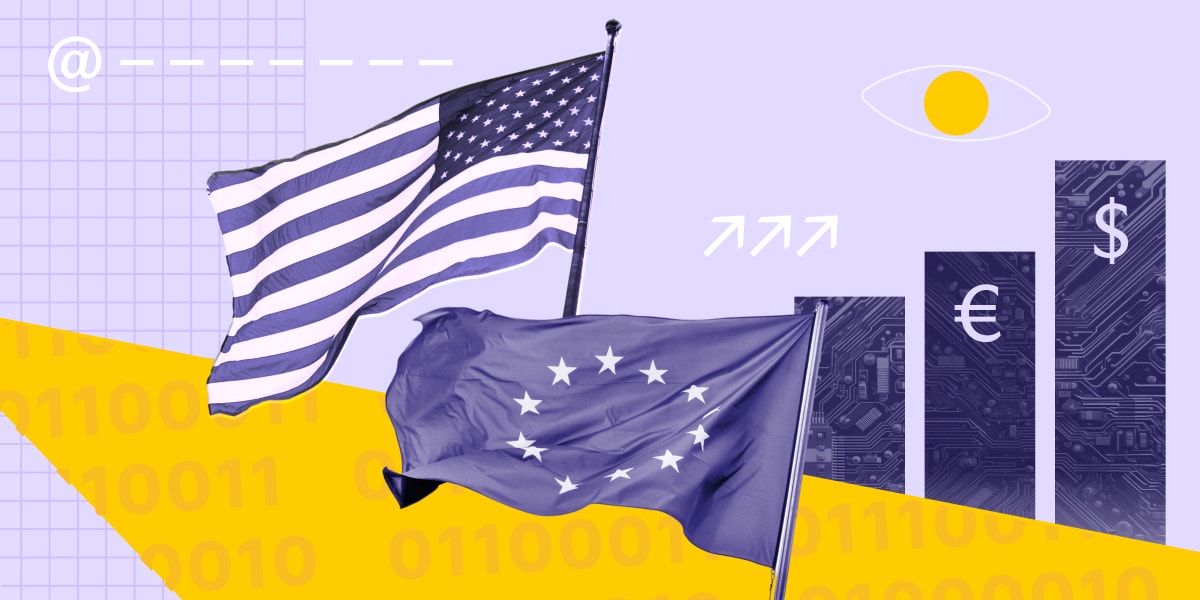
Across Europe, most companies run on American technology — often without realizing just how much of their day‑to‑day operations depend on it. From email and video calls to customer support systems, hundreds of mission-critical tools pass through a handful of US platforms.
For decades, that felt like a reasonable trade‑off: powerful tools, competitive prices, and confidence in the US as a geopolitical ally. But those assumptions no longer hold: Big Tech tools are no longer the only option, and EU policymakers believe they’re not worth the price of European sovereignty.
As political tensions intensify and privacy demands increase, Europe’s reliance on US tech is starting to look less like a convenience and more like a liability — especially for small- and mid-sized businesses without a business continuity option.
To help European businesses navigate the uncertainty and the transition to tech sovereignty, Proton is releasing a new intelligence report today, US tech dependence: A risk report for European businesses. In it, we examine how this dependence developed, where it creates risk, and what leaders can do to regain control.
How deep does Europe’s dependence go?

Proton has been tracking Europe’s reliance on US tech for several years. The picture that emerges from our latest research and market analysis is clear:
- Over 74% of Europe’s publicly listed companies rely on US‑based providers like Google and Microsoft for critical services.
- As of 2025, US cloud providers control more than 70%(nouvelle fenêtre) of the European cloud market; European vendors hold less than 15%.
- In a Proton survey of 3,000 people across the UK, Germany, and France, 73% said Europe is too dependent on US tech companies, and 83% expressed concern about that dependence.
This all means that sensitive business information, strategic plans, and everyday operations across the continent sit on infrastructure controlled outside Europe’s legal and political system, leaving European companies exposed to decisions taken elsewhere. The result is a structural dependence that underpins nearly every sector from finance and healthcare to manufacturing, media, and even the government.
Why tech sovereignty matters more than ever
Dependence on US tech is not new. What is new is the combination of pressures Europe now faces from Washington — and the way those pressures intersect with critical digital infrastructure.
As Finnish MEP Aura Salla puts it: “The EU runs on Microsoft. The US could turn us off inside one hour.”
Several recent developments have made this issue too big to ignore:
- Sanctions and tech access are tightly linked. In recent years, US sanctions(nouvelle fenêtre) have cut off targeted individuals and institutions from mainstream American services overnight, including email, payment platforms, and cloud tools. When the chief prosecutor of the International Criminal Court lost access to his Microsoft inbox following US sanctions, it sent a clear signal: Access to US platforms can be wielded for geopolitical ends.
- Transatlantic relations have become progressively strained. In his second term, President Trump has raised tariffs on European exports, floated the idea of leaving NATO, and threatened retaliation when the EU enforces its own laws against US tech companies. Senior US officials have framed EU fines on American platforms(nouvelle fenêtre) as attacks on “the American people”. In other words, digital infrastructure now risks becoming a bargaining chip.
- US surveillance laws reach into European data. The CLOUD Act and Section 702 of the Foreign Intelligence Surveillance Act permit US authorities to request access to data held by American companies, even when that data belongs to Europeans and is stored in the EU.
- Europe is trying to assert digital sovereignty, but still runs on US systems. European governments have announced plans to move away from US platforms in sensitive areas, launched initiatives to strengthen tech sovereignty, and passed laws such as the EU Data Act(nouvelle fenêtre) to constrain foreign access to European data. But the irony is most of its businesses and institutions still rely on US infrastructure for core operations.
These developments mean Europe now faces a paradox: It is trying to defend its laws, norms, and strategic interests while running those defenses on systems ultimately governed by someone else’s rules.
How much is your business at risk?
Some organizations are more exposed than others. Based on our research, certain patterns tend to correlate with higher risk.
Which of these statements are true for your business:
- Most of your core tools sit with one US provider. Many organizations default to Big Tech ecosystems such as Google and Microsoft, mostly for convenience. But this also means a single outage or policy change can disrupt multiple functions at once.
- Your SaaS vendors still rely on US clouds. While your stack may come from different vendors and look varied on the surface, they may still rely on a US cloud provider like AWS and therefore be subject to US data jurisdiction.
- You manage EU customers or sensitive data on US platforms. If your business serves European or public‑sector clients, processes health or financial data, or operates in a regulated industry, that information is subject to US laws. This can cause potential conflicts with European privacy and data protection rules.
- Security and compliance are left to your providers. If asked, would you be able to easily explain your vendors’ policies on security and privacy? Simply trusting that your providers will “do the right thing” means limited independent verification of how your data is actually accessed, logged, or shared — and these policies can change at a moment’s notice.
- There is no clear exit plan. Migrating away from your main US provider would take months of preparation and significant disruption. There is no tested scenario, or any alternatives in mind, if access is suddenly affected.
If several of the points above sound familiar, your dependence on US tech may be deeper — and more precarious — than it appears. You’re not alone: The real question is what to do next.
Maneuver now, while you still have room
Over the past decade, we’ve seen how easily control can slip away when critical infrastructure is outsourced, and how hard it is to regain once that happens. As a privacy-first, Swiss-headquartered company, Proton is built on the belief that people and organizations should control their data — and, by extension, their future.
This report is part of that effort, providing detailed analyses and actionable insights that any business can use to understand its position and plan ahead. US tech dependence: A risk report for European businesses gives you:
- An overview of the current landscape, including how and why Europe became reliant on US tech
- A breakdown of the main risk areas, from geopolitics and outages to surveillance and compliance
- Real‑world examples that show how these risks have already disrupted organizations
- 13 practical mitigation strategies you can implement now
The pressure on European businesses is already building. Waiting until a sanction, policy change, or major outage hits your providers is the most expensive way to find out how much your business is at the mercy of external forces. Acting now — while the choice is still yours — gives you options instead of emergencies.